
Quick answer
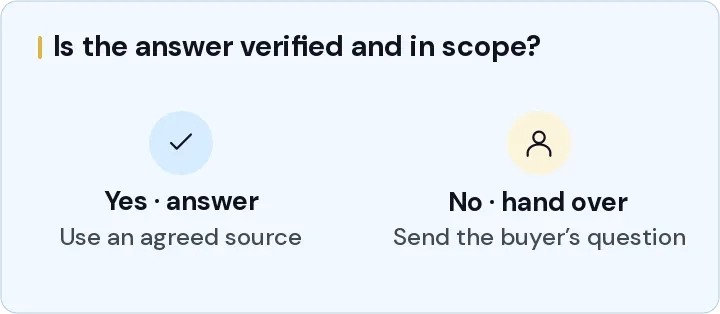
Give the chatbot a clear handover when a customer asks for a person, needs a decision outside the approved information, or reaches a step the bot cannot complete reliably. The receiving team needs the conversation and a specific next action. A handover is only useful once someone is responsible for picking it up.
For a UAE property business, that boundary matters around availability, viewing arrangements and claims about a property. We'd define what the assistant may say from verified information before deciding how much of the conversation to automate.
On this page
Decide what the assistant can know
Start with the information source. If an assistant is expected to answer questions about particular homes, identify where the current approved listing information comes from and who updates it. A brochure, a website page and an internal inventory can contain different versions of the same detail.
Give each answerable field an owner. Availability may need staff confirmation, while an approved property description may be suitable to show as written. A model's fluent response does not establish that it has current information or permission to make a commitment.
This is a practical scoping decision. The assistant can still help collect a customer's question when a reliable answer is unavailable. Its response should make the next step clear without guessing the missing detail.
Use a worked handover
Here is a fictional website-chat exchange. It is a proposed example for discussion, not a transcript from a live NST deployment.
Scroll the table to see all columns.
| Conversation point | Proposed assistant behaviour | Staff handover |
|---|---|---|
| Visitor asks whether a particular home is still available | Check the approved source; if current status is unavailable, say the team needs to confirm | Include the listing reference and the exact availability question |
| Visitor asks to view tomorrow afternoon | Collect the requested window without promising a booking | Assign a person to confirm the appointment |
| Visitor asks to negotiate a price | Avoid inventing terms or implying authority to negotiate | Send the request and context to the responsible agent |
| Visitor says “Can I speak to someone?” | Offer the supported human-contact route immediately | Preserve the conversation so the visitor need not start again |
A useful handover note could read: “Visitor asked about listing EX-204, wants a viewing tomorrow afternoon, availability not confirmed. Please check the listing and reply through the agreed channel.” The fictional reference makes it possible to test the workflow without using a customer's personal details.
Make ownership visible to the receiving team
Choose the place staff will see a handover. That might be a shared inbox or a CRM queue, but it needs an accountable person and coverage outside normal working hours. A notification sent to an unattended channel leaves the visitor waiting just as a missed form does.
The team should be able to distinguish a new handover from one already being handled. Decide how assignment, reassignment and completion work. If the customer replies again while a person is responding, agree whether the assistant pauses and how staff see the new message.
Our WhatsApp enquiry ownership guide covers those operational questions for a shared inbox. They remain relevant when an AI assistant is another participant in the route.
Test the points where automation should stop
Before a pilot, run a small set of fictional enquiries through the proposed flow. Include an unavailable listing, a request in Arabic and a customer who changes their mind. Someone familiar with the business should review the answers and the resulting handovers.
Also test missing information and a failed connection. If the listing source cannot be reached, the assistant needs an agreed response and a way to pass the question on. Repeated uncertainty should be visible to the team rather than concealed behind increasingly confident wording.
OpenAI's practical guide to building agents discusses human intervention for sensitive actions and failed attempts. For this buyer worksheet, the important decision is which actions your business is comfortable allowing and which require a person. Naming those boundaries gives a supplier something concrete to build and test.
Keep the first scope small enough to assess
A first pilot might cover questions from one website section and a single staff handover route. Decide which data is necessary, who can see it and how long the business needs to keep it. Avoid collecting documents or extra personal information simply because a chat interface makes it easy.
Review the pilot using conversation accuracy, successful handovers and staff follow-up. A total conversation count can describe activity, but it will not explain whether the team received useful enquiries. Keep examples of missing context so the next iteration has a specific problem to solve.
If you are considering this workflow, NST's AI Solutions service can help define the assistant's permitted work and human handover. Send us one enquiry type you would like to handle and how staff respond today.
Define a useful AI handover
Choose one enquiry type and agree what the assistant may do before deciding how much to automate.
Keep reading

How to assign WhatsApp enquiries when three people answer the inbox
Give each WhatsApp enquiry an owner, keep context when customers reply, and check shift handovers with a worked team workflow and acceptance checklist.

What changes the cost of a business website in Sharjah?
Compare website scopes, content responsibilities and running costs. Use a sample Sharjah business brief to request a clearer website quote.

Why is your business website slow on mobile?
Use a mobile speed review, a worked repair brief and a retest checklist to decide which website problems need fixing first.