
Quick answer
A useful project case study helps a prospective customer understand what you were asked to do, what you delivered and which details they can verify. Start with the material you have permission to show, then explain the decisions that matter to someone considering similar work. You can write a worthwhile case study without a revenue chart or a dramatic before-and-after claim.
For a service business, that might mean explaining how a project was scoped, showing an approved finished detail and describing what the customer received at handover. The outline below gives you a way to collect that material before writing.
On this page
Choose the question this project can answer
A project page has a job beyond adding another image to a portfolio. Someone considering a bilingual website might want to see how the navigation works in both languages. A property manager reviewing maintenance work may need to understand the area covered and what was included.
Choose a project that can answer the question with evidence you actually have. You don't need to attach every service your business offers. A clear account of one relevant task can be easier to assess than a general story about an entire customer relationship.
That question also helps you choose the title. Naming the type of work and a useful detail tells a reader more than “another successful project”.
Collect the material you can publish
Before drafting, agree with the client what can be named and shown. That includes their name or logo, project photos, screenshots and any quotation you want to use. Check whether images contain personal information or details of an internal system.
Keep the permission with the project material so the person uploading the page can see its boundaries. If a client approves one screenshot, that doesn't automatically cover every screen in the project. An anonymised example still needs care if the details could identify the business.
A project without shareable client material can still inform an internal planning exercise. If you publish a fictional demonstration instead, label it as a demonstration and describe what it shows.
Fill in a short project outline
Use this worksheet to collect facts before writing the page. It also exposes missing evidence early, while you can still ask the right person.
Scroll the table to see all columns.
| Part of the story | Material to collect | Question it should answer |
|---|---|---|
| The task | Approved brief or a checked description of the request | What did the customer need to be able to do? |
| The decision | A specific scope, design or implementation choice | Why did this approach fit that request? |
| The delivery | Finished work, a walkthrough or handover material | What was actually supplied? |
| The outcome | A checked observation or an agreed measurement | What can you support beyond the delivery itself? |
| The next step | The relevant service and information needed for a new brief | How can someone with a similar need start a conversation? |
You may have strong delivery evidence and no outcome measurement. That is useful to know. The page can explain the work without adding a claim that has no source.
Turn the facts into a worked paragraph
Here's a fictional example for a maintenance company's website project:
“The company needed prospective customers to understand its maintenance services and send a request for a site visit. The brief included service descriptions and a project section, with the office supplying approved photos. The page structure groups the services around the questions a property manager needs to answer before making an enquiry. At handover, the office can update those descriptions and add project material through the agreed editing fields.”
Each statement in a real case study would need checking against the brief and delivered website. If the editing fields were only a proposal, the last sentence would need to say so. The paragraph doesn't establish that enquiries increased.
For an example of the kind of work a project page can identify, our published MMCO website project describes a corporate site for a Sharjah construction, maintenance and technical-services company. Its published scope is evidence of website work; it isn't evidence of marketing campaign results.
Choose images that explain the decision
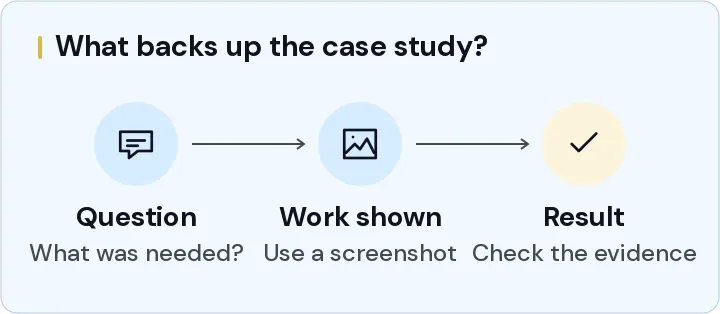
A whole-page screenshot can show the overall layout, while a closer view might explain an editing screen or a mobile interaction. Choose the view that supports the paragraph beside it. Captions can tell readers what to notice without repeating the heading.
If you show a prototype, say that it is a prototype. If a screenshot comes from the finished site, identify the relevant part of the delivered work. Avoid presenting a concept image as a live result.
The same project can supply a useful social post once the permissions cover that use. Our content calendar guide includes a production brief for deciding the format, the material needed and who approves it. The social post should still explain the work clearly to someone who hasn't read the full case study.
Keep results and delivered work distinct
A working form, an approved design and an increase in qualified enquiries are different statements. Describe the one your evidence supports. If you publish a measured improvement, include the period and what was counted, along with any limitation that affects the comparison.
A testimonial needs the customer's approval and their actual words. You can ask a client to comment on a specific part of the work, but a sentence written internally shouldn't appear as their quotation without agreement.
When a measurement is missing, the case study can end with what was delivered and how it serves the original brief. That gives a reader something concrete to discuss.
Plan how the project fits your website
Link the case study from the relevant service page so a reader can move from the offer to an example. In the case study itself, explain what information someone with a similar project should send. Our website quote worksheet can help them prepare that brief.
NST's Website Development service covers the website structure and build discussion. For adapting approved project material into a content plan, you can also discuss Social Media Management.
Send NST the project material you'd like to explain, with the permission boundaries and the customer question you want the page to answer.
Give your project work a useful place
Plan how services and approved project material fit together on your business website.
Related work

Keep reading

What changes the cost of a business website in Sharjah?
Compare website scopes, content responsibilities and running costs. Use a sample Sharjah business brief to request a clearer website quote.

A two-week social media content calendar for a service business
Use a filled-in two-week calendar and reusable production brief to plan posts, assign approvals and scope content creation support.

What drives the cost of a mobile app in Dubai?
Compare published Dubai mobile app costs in AED, see what goes into a real design prototype, and use a checklist to scope your first release.